If anyone reads this, I moved to Wordpress
If anyone reads this, I moved to Wordpress
If anyone reads this, I moved to Wordpress
If anyone reads this, I moved to Wordpress
If anyone reads this, I moved to Wordpress
If anyone reads this, I moved to Wordpress
If anyone reads this, I moved to Wordpress
Anthony
Saturday, January 2, 2010


Tuesday, October 27, 2009
Papua New Guinea: Madang and the North Coast
**Sorry it took me so long to post this- I just moved to Philadelphia, and have been busy looking for work and settling in here. That being said, I probably could have finished it sooner.**
Although the time we spent in the village was altogether new, exciting, beautiful, and humbling, something about cool weather, daily rain, and a steady diet of boiled root vegetables that lacked what the term "vacation in the tropics" evokes. To remedy this, Dan and I set out with my aunt, uncle, and cousin on the road to Madang, a coastal town with some nice beach resorts and beautiful coral reefs.
As with every trip in PNG, just getting there was an adventure in itself. The road to Madang took us down a mountain pass, through a flat valley full of sugar cane and oil palm plantations, and turned to a muddy dirt track cut through thick forests that roller-coastered up and down huge hills. Fortunately we were driving in Kathy and Neil's truck, so we didn't share the fate of the overloaded PMV's we passed as they wheezed and struggled up the slippery road. We later encountered a river ford, which involved driving over a concrete slab laid in a riverbed with about six inches of water flowing over it. Once the road the road turned back to pavement, it was smooth sailing... for about a quarter mile at a time. The sections of smooth pavement allowed the truck to reach about 40mph, at which time the headlights would reveal what appeared to be a gaping void. We'd brake just in time to roll over a set of monumental potholes, accelerate and repeat the process about a dozen times.
 The Ramu valley, on the road to Madang
We got to Jais Aben resort late and fell into bed. When the next morning dawned, we could see how beautiful the place was. The rooms at the resort were made up of little duplex cabins right on the water, with huge trees stretching out over a bank undercut by waves. We were so close that the spray from the high-tide waves would get our windows wet.
 The view from our cabin
Although the time we spent in the village was altogether new, exciting, beautiful, and humbling, something about cool weather, daily rain, and a steady diet of boiled root vegetables that lacked what the term "vacation in the tropics" evokes. To remedy this, Dan and I set out with my aunt, uncle, and cousin on the road to Madang, a coastal town with some nice beach resorts and beautiful coral reefs.
As with every trip in PNG, just getting there was an adventure in itself. The road to Madang took us down a mountain pass, through a flat valley full of sugar cane and oil palm plantations, and turned to a muddy dirt track cut through thick forests that roller-coastered up and down huge hills. Fortunately we were driving in Kathy and Neil's truck, so we didn't share the fate of the overloaded PMV's we passed as they wheezed and struggled up the slippery road. We later encountered a river ford, which involved driving over a concrete slab laid in a riverbed with about six inches of water flowing over it. Once the road the road turned back to pavement, it was smooth sailing... for about a quarter mile at a time. The sections of smooth pavement allowed the truck to reach about 40mph, at which time the headlights would reveal what appeared to be a gaping void. We'd brake just in time to roll over a set of monumental potholes, accelerate and repeat the process about a dozen times.
 The Ramu valley, on the road to Madang
 The view from our cabin
The resort itself was fairly typical for tourist accomodation in the country: a very nice location, grounds and facilities, but lacking in the consistency that an American traveler would expect. One good example came at every meal, when whatever one or two of us ordered was out. It was never the same thing twice, but you could be assured that something was out. Once, when my cousin ordered a chocolate mousse, I noticed that it didn't look like it had in the past. With a closer look and a taste, I determined it to be cake batter. On the whole, the food wasn't boiled vegetables, so I'm not complaining.
On the upside there was... everything else. The weather was beautiful, hot but not very humid, the snorkeling literally right out our door was beautiful, and thanks to my uncle Neil, we made the acquaintance of a local villager named Chris, who gave us a great local perspective on the area.
 Chris and his son
 Chris' canoe on the island
It's hard to see in my lousy video, but the trickiest part comes when he's directly under the top of the tree and has to pull off any dead fronds and has to pull off any dead ones that could give out when he wrestles his to the treetop where the coconuts grow.
The next day we decided to head up the coast to another hotel where we ate lunch and went swimming at the black-sand beach.

There's a huge volcano in the background, at right half obscured by clouds.
The next day Chris also made us some harpoons out of metal rods cut from heavy fencing and some rubber tubing rigged up as launchers. We took them out to the beach next to the village for some practice trying to skewer some pretty little reef fish. Fortunately for them, I'm a very bad shot and after a couple of hours, I hadn't done more than annoy the fish that easily escaped my harpoon. Of course, when I finally gave up for the day, the six- to ten-year-old kids who were hanging out borrowed my harpoon gun and proceeded to get a bunch of fish.
 For our last day, Chris borrowed a boat and took Dan, Tony, and I on an all-day spearfishing and beach hangout extravaganza along with about a dozen kids from the village. We all piled onto a decent-sized motor boat and took off for an island that's a popular hangout for people in the area.
 Our crew on the boat
 Another boat heading to the island
On the upside there was... everything else. The weather was beautiful, hot but not very humid, the snorkeling literally right out our door was beautiful, and thanks to my uncle Neil, we made the acquaintance of a local villager named Chris, who gave us a great local perspective on the area.
 Chris and his son
He took Dan, our cousin Tony and I our on his canoe to a little island close to his village, where we snorkeled around the island and combed the beach for seashells and coral pieces, which were everywhere.  Dan, Tony, and Chris with the island in the background
 Dan, Tony, and Chris with the island in the background
 Chris' canoe on the island
We also got to witness Chris climbing a 50-foot coconut tree with ridiculous ease.
It's hard to see in my lousy video, but the trickiest part comes when he's directly under the top of the tree and has to pull off any dead fronds and has to pull off any dead ones that could give out when he wrestles his to the treetop where the coconuts grow.
The next day we decided to head up the coast to another hotel where we ate lunch and went swimming at the black-sand beach.

There's a huge volcano in the background, at right half obscured by clouds.
The next day Chris also made us some harpoons out of metal rods cut from heavy fencing and some rubber tubing rigged up as launchers. We took them out to the beach next to the village for some practice trying to skewer some pretty little reef fish. Fortunately for them, I'm a very bad shot and after a couple of hours, I hadn't done more than annoy the fish that easily escaped my harpoon. Of course, when I finally gave up for the day, the six- to ten-year-old kids who were hanging out borrowed my harpoon gun and proceeded to get a bunch of fish.
 For our last day, Chris borrowed a boat and took Dan, Tony, and I on an all-day spearfishing and beach hangout extravaganza along with about a dozen kids from the village. We all piled onto a decent-sized motor boat and took off for an island that's a popular hangout for people in the area.
 Our crew on the boat
 Another boat heading to the island
When we got to the island, the festivities began. The kids who had scuba masks or swimming goggles took off into the water and immediately began hunting fish mercilessly. Dan, Tony and I joined in and despite my best efforts, I managed to get a nice little fish right through the head. In the meantime, the kids had already put together several strings loaded with little fish.


some of the day's catch
Meanwhile, another boat overflowing with adults and kids came ashore, and several games of rugby/soccer/keepaway started. Everywhere there were kids running around, yelling, and doing flips into the water.

After several hours of swimming and playing around on the beach, we finally headed back to the village for some dinner. Although the kids caught a bunch of fish, they had already eaten most of them on the island, so we "caught" some fresh tuna from some Filipino sailors on giant tuna boats anchored nearby.
 Dinner! Some of the best food we had in PNG

After several hours of swimming and playing around on the beach, we finally headed back to the village for some dinner. Although the kids caught a bunch of fish, they had already eaten most of them on the island, so we "caught" some fresh tuna from some Filipino sailors on giant tuna boats anchored nearby.
 Dinner! Some of the best food we had in PNG
They also made us some Kava, which is a drink made from a crushed root that produces a sedative effect. They all made a big deal of how strong it was, but the effect was pretty mild, kind of like the opposite of coffee, with some slight facial numbness.
 Drinking Kava
 Baby in a Bag!
 Baby in a Bag!
 Drinking Kava
 Baby in a Bag!
 Baby in a Bag!
After the meal, we went about the long process of saying goodbye to Chris, his family, and everyone else who was hanging around. This of course required a long session of group photos!

 Chris' sister Adele and her neice
 Chris and his sons

 Chris' sister Adele and her neice
 Chris and his sons
Chris and a bunch of the kids from the village walked us back to our cabin at the resort. We thanked Chris, trying our best to successfully convey how grateful we were. He and his family made our last week in the country really memorable and pretty damn fun.
Sunday, October 18, 2009
Papua New Guinea: Village Life
After spending a week in Goroka, Dan, uncle Neil and I got ready to travel to the village of Samanzing, where he and my aunt Kathy do their translation work. We would take a PMV (public motor vehicle) on the five-hour trip from Goroka down to Lae on the coast, where we would spend a night and catch another PMV up to the end of the closest road to village, then hike eight hours to reach their village.
In Papua New Guinea, the public transportation is not run by the state; instead, the government grants permits for private vehicle to charge fares to carry passengers and cargo on a specified route. There are three main types of PMV: minivans allowed to carry 15, small buses that carry 25, and flatbed trucks which generally appeared to carry as many as possible. The crew on a typical PMV consists of a driver and one or two others, who hustle passengers and their cargo on and off the vehicle. When they are in a market, one will hang his head out the window and call out the destination over and over as fast as possible. When we got to the Goroka market, we searched the nearly identical toyota vans until we heard the call Lae-Lae-Lae-Lae-Lae! The PMV crew urgently gestured us over to the van, where we saw that there was only one seat left. By this time the crew was already attempting to jam our bags anywhere they could in the jam-packed cabin. I started to protest, to say that all three of us couldn't fit, when the 'baggage handlers' gestured to two of the passengers, who immediately got out of the van. Then they gestured to the newly vacated seats, and we squeezed aboard. I really felt bad about the guys who got kicked off, and how we got their seats because of our white skin, but later my uncle explained the real situation. PMVs will usually only depart once they've filled every possible seat, so the driver will get some of his buddies to fill most of the remaining seats on a half-full van. Potential passengers will be much more likely to get on a PMV that's about to depart, so they'll take the last open seat. One of the driver's buddies will get out, and the process is repeated until the van is full of real passengers.
Once we were packed into the van, our fare of 20 Kina (about eight dollars) was collected and we were underway. We headed east on the Highlands Highway, a narrow two-lane road that connects the Eastern Higlands with the coastal industrial city of Lae. The highway weaves through the highlands with lots of blind corners and many pedestrians and animals walking along the roadsides. This doesn't stop the PMV drivers from attacking the road at the fastest speed possible, passing other vehicles in the tightest of spots, and using the opposite lane to negotiate tricky corners while the tires squeal and the diesel engine strains. Our driver preferred to straddle the centerline of the road and would often mess around with oncoming PMVs by taking the opposite lane and waiting until head-on collision was uncomfortably close before moving out of the way. Periodically the road would be severely washed out and the driver had to come to a quick stop, then slowly roll over massive potholes. Slow traffic around the washouts also made a good opportunity for the driver to pass whatever other vehicles he could.
After our white-knuckle ride to Lae and a night in a hotel, we grabbed a PMV ride to Hobu, where the nearest road to the village ended. We started out on the trail, hiking in the intense tropical sun for a couple of hours before reaching the top of a ridge where we could see toward Lae and the ocean. On the other side were nothing but ridge tops poking out of clouds that clung thickly to the hillsides. Somewhere down in the clouds was Bilima, the village we would stay for the night before moving on to Samanzing.
 The view toward Bilima
In Papua New Guinea, the public transportation is not run by the state; instead, the government grants permits for private vehicle to charge fares to carry passengers and cargo on a specified route. There are three main types of PMV: minivans allowed to carry 15, small buses that carry 25, and flatbed trucks which generally appeared to carry as many as possible. The crew on a typical PMV consists of a driver and one or two others, who hustle passengers and their cargo on and off the vehicle. When they are in a market, one will hang his head out the window and call out the destination over and over as fast as possible. When we got to the Goroka market, we searched the nearly identical toyota vans until we heard the call Lae-Lae-Lae-Lae-Lae! The PMV crew urgently gestured us over to the van, where we saw that there was only one seat left. By this time the crew was already attempting to jam our bags anywhere they could in the jam-packed cabin. I started to protest, to say that all three of us couldn't fit, when the 'baggage handlers' gestured to two of the passengers, who immediately got out of the van. Then they gestured to the newly vacated seats, and we squeezed aboard. I really felt bad about the guys who got kicked off, and how we got their seats because of our white skin, but later my uncle explained the real situation. PMVs will usually only depart once they've filled every possible seat, so the driver will get some of his buddies to fill most of the remaining seats on a half-full van. Potential passengers will be much more likely to get on a PMV that's about to depart, so they'll take the last open seat. One of the driver's buddies will get out, and the process is repeated until the van is full of real passengers.
Once we were packed into the van, our fare of 20 Kina (about eight dollars) was collected and we were underway. We headed east on the Highlands Highway, a narrow two-lane road that connects the Eastern Higlands with the coastal industrial city of Lae. The highway weaves through the highlands with lots of blind corners and many pedestrians and animals walking along the roadsides. This doesn't stop the PMV drivers from attacking the road at the fastest speed possible, passing other vehicles in the tightest of spots, and using the opposite lane to negotiate tricky corners while the tires squeal and the diesel engine strains. Our driver preferred to straddle the centerline of the road and would often mess around with oncoming PMVs by taking the opposite lane and waiting until head-on collision was uncomfortably close before moving out of the way. Periodically the road would be severely washed out and the driver had to come to a quick stop, then slowly roll over massive potholes. Slow traffic around the washouts also made a good opportunity for the driver to pass whatever other vehicles he could.
After our white-knuckle ride to Lae and a night in a hotel, we grabbed a PMV ride to Hobu, where the nearest road to the village ended. We started out on the trail, hiking in the intense tropical sun for a couple of hours before reaching the top of a ridge where we could see toward Lae and the ocean. On the other side were nothing but ridge tops poking out of clouds that clung thickly to the hillsides. Somewhere down in the clouds was Bilima, the village we would stay for the night before moving on to Samanzing.
 The view toward Bilima
When we went over the first ridge, the weather and the forest seemed to change instantaneously. Thick clouds moved around us, sometimes dropping scattered rain on us. The vegetation was thick, so green, and nearly every tree and plant seemed to have another plant growing on it. We continued to hike the steep trail as it wound its way up and over ridges, across a river gorge, and over huge slopes scraped bare by landslides.

PNG hiking style: bare feet, heavy load, machete in hand.
After a few more hours, we arrived at the home of Yanga, a close friend of uncle Neil's who put us up in his family's traditional wood and bamboo house. The Mesem people construct their houses on stilts, using thin logs for the framework, hand-hewn boards for siding, flattened woven bamboo flooring, and a special type of dried leaves brought from the coast for roofing.
 Yanga's house
 Yanga's wife at the hearth with two of her daughters
 A village house in need of a new roof (new roofing is stacked under the
house at bottom left)

PNG hiking style: bare feet, heavy load, machete in hand.
 Yanga's house
All of the cooking is done in the house, over the open hearth. The Mesem don't use chimneys, so the smoke just seeps through the roof. Despite making the house really smokey, the woodsmoke actually helps preserve the leaves used for the roof by coating them with soot, which prevents plants from growing and weakening the roof. You can tell which houses are in need of a new roof by the number of plants sprouting out of them.
 Yanga's wife at the hearth with two of her daughters
 A village house in need of a new roof (new roofing is stacked under the
house at bottom left)
The next day, after a long church service led by Yanga in the Mesem language (which Dan and I did not understand at all,) some of the kids in the village became the tour guides of the day, taking us to a beautiful forty-foot waterfall, then getting us into a big, village-wide volleyball match that included everyone from middle-aged men to young children. The game was a great way to relate to the village people since we didn't have to know the language to join in on the fun. We played for hours, just knocking the ball around without keeping score.
 While we were in Bilima, we also met a tame cockatoo named Cookie. He was adopted when some village guys cut down a tree and the young Cookie was found still in a nest. Since then he's been hand fed, and visits different houses in the village to beg for food by calling Cookie kai kai!, meaning 'Cookie eat!' or 'Cookie food!' The people oblige by feeding him some taro root or whatever they can spare. The guys who look after him also colored him with some blue ink so no one would try to hunt their pet bird. Cookie is so tame that he endures a ridiculous amount of prodding and harassment at the hands of the village kids, who gleefully provoke the bird without any regard for its big sharp beak. Fortunately Cookie never sought his revenge and took the abuse in stride.

 Yanga's son Neil (named after my uncle) treats Cookie a little nicer
 While we were in Bilima, we also met a tame cockatoo named Cookie. He was adopted when some village guys cut down a tree and the young Cookie was found still in a nest. Since then he's been hand fed, and visits different houses in the village to beg for food by calling Cookie kai kai!, meaning 'Cookie eat!' or 'Cookie food!' The people oblige by feeding him some taro root or whatever they can spare. The guys who look after him also colored him with some blue ink so no one would try to hunt their pet bird. Cookie is so tame that he endures a ridiculous amount of prodding and harassment at the hands of the village kids, who gleefully provoke the bird without any regard for its big sharp beak. Fortunately Cookie never sought his revenge and took the abuse in stride.
 Yanga's son Neil (named after my uncle) treats Cookie a little nicer
After two nights in Bilima, we hiked out to Samanzing along with another gang of kids and teenagers, who insisted on carrying our bags. I protested, trying to tell them that I could carry my own bag, but my uncle ensured me that they were being hospitable and I should accept. As it happened, a teenage girl ended up carrying my bag by putting the waist strap on her forehead and letting the bag hang upside down on her back. As we headed on down the trail, I felt every bit like some jackass explorer, haplessly wandering through the jungle with my army of porters.
When we got to Kathy and Neil's house in Samanzing, Dan and I were pretty surprised by how modern the place was, considering it's location. They had a gas stove, solar-powered hot and cold running water, and electricity from a small generator. Unfortunately, the scene in Samanzing was much more subdued than in Bilima, largely because one of the village men is mentally ill, and Neil's arrival invariably causes his condition to get worse. People were afraid that he might cause trouble, so Neil's friends would instead come to the house, where we would hang out.
One of the young guys in the village did take us out to see his garden above the village and brought us on a tour around the area. Masta was around 18 and is an entrepreneur, raising chickens and selling them in the village for a few kina. He also grows yams, taro, bananas, and sugarcane.
 Masta with his new Alta shirt!
When we got to Kathy and Neil's house in Samanzing, Dan and I were pretty surprised by how modern the place was, considering it's location. They had a gas stove, solar-powered hot and cold running water, and electricity from a small generator. Unfortunately, the scene in Samanzing was much more subdued than in Bilima, largely because one of the village men is mentally ill, and Neil's arrival invariably causes his condition to get worse. People were afraid that he might cause trouble, so Neil's friends would instead come to the house, where we would hang out.
One of the young guys in the village did take us out to see his garden above the village and brought us on a tour around the area. Masta was around 18 and is an entrepreneur, raising chickens and selling them in the village for a few kina. He also grows yams, taro, bananas, and sugarcane.
 Masta with his new Alta shirt!
Masta showed us his garden and set about getting a chicken for our dinner. He called over his chickens with a clucking call, then Masta's little brothers selected a chicken and commenced pelting it with their slingshots until it was stunned. Then one of them picked it up by the feet and bashed it against a stump a few times, making sure it was good and dead. After some of the guys removed the feathers and innards, it was clear this was no factory farm bird. it was no more than a couple pounds, and once we roasted it, it was pretty tough. But it was meat, something that we hadn't had much of since we headed to the bush. Aside from the chicken dinner, we had been eating what the villagers eat, which involved lots and lots of boiled taro and greens. Ever since we arrived in the village, Neil's friends would bring a pot of food over and it would invariably be boiled or roasted taro. They simply don't have the resources to eat enough protein, and subsist mainly on a diet of vegetables supplemented occasionally by the meat of a slaughtered chicken or pig. Eating what they eat for a week made it abundantly clear what a luxury a varied and nutritionally balanced diet is.
 Breakfast (and lunch, and dinner) time! Boiled taro and greens.
 Breakfast (and lunch, and dinner) time! Boiled taro and greens.
After four nights in Samanzing, we got back on the trail out of the bush, stopping in Bilima to stay another night with Yanga and his family. After a big meal of rice, canned mackeral, and sweet potato, Dan gave Yanga some shirts, a hat, and a flashlight in thanks for his family's hospitality. Yanga was thrilled and grateful, and over very sweet after-dinner tea, Yanga and his son taught us some simple magic tricks with matchsticks. Despite the huge gulf between our languages and cultures, we had a great time trying to figure out their tricks. It was one of the high points of the trip. Their hospitality and generosity were humbling.
 Yanga and his youngest daughter
 Yanga's wife and the girls
 Yanga's son Neil holding giant 'bush turkey' eggs
 Yanga and his youngest daughter
 Yanga's wife and the girls
 Yanga's son Neil holding giant 'bush turkey' eggs
After the obligatory photo shoot, we hit the trail toward the road and caught a PMV to Lae.
Within hours we were stuffing ourselves at Golden Rooster, the PNG equivalent of KFC. Fortunately there was no taro on the menu.
Within hours we were stuffing ourselves at Golden Rooster, the PNG equivalent of KFC. Fortunately there was no taro on the menu.
Sunday, October 11, 2009
Papua New Guinea: Introduction
Before I get into the details of my trip, I want to explain the reasons why my brother and I took nearly a month to fly about halfway around the world and tour around a country most people have never heard of. We probably would never have heard of Papua New Guinea ourselves had it not been for the sake of Neil and Kathy Vanaria, our aunt and uncle. They first came to the country in 1988 to engage in Christian missionary work and have worked on linguistics and bible translation for the Mesem people of Morobe Province for the bulk of that time.
Before we traveled to PNG, I admit I had an inaccurate view of their work, conjuring up the absurd image of my intelligent, good-humored aunt and uncle hustling people into church where they would thump their bibles and preach with religious fervor glinting in their eyes. That's a big exaggeration, but I did always assume that their role involved actively leading a church. In fact, the missionaries who built churches and preached to the Mesem people came and went years ago. Today, church services are conducted by Mesem people and although Neil and Kathy are both ministers, they only speak in church if they are asked to. What they have been doing all this time is is the daunting job of translating the New Testament into the Mesem language. This may not sound like over twenty year's worth of work, but their job does not mean plugging the text into Babelfish and sending the results to the printer's. Instead, they had to learn the language, create a written language since the Mesem had none, teach people to read it, employ Mesem people to help with translation, THEN go about the task of translating the text. Not to mention all the while they're dispensing basic medical care, enduring a variety of injuries and tropical illnesses, and raising their son Tony, now 16. Oh yeah, they're also the world's only non-native Mesem speakers.
Aside from their knowledge of the Mesem, they've lived and traveled to several parts of the country and are very familiar with the logistics of getting around and sightseeing in PNG. Needless to say, they were the perfect guides for us to experience what PNG is really like.
Before I talk about where we went, here's a map of the country with some markers on the places we visited:
View Papua New Guinea in a larger map
We started our travel in PNG by flying from Port Moresby, the capital, to Goroka, where our aunt and uncle had just moved just a week before after a two-year sabbatical in the US. Kathy and Neil live a few miles outside of town in what is basically a fenced and guarded housing development. They aren't wealthy by American standards and they don't seek to alienate the locals, but fences and guards are simply a fact of in a place where white people are all assumed to be wealthy. In a way this is correct since around 90% of the people in PNG are subsistence farmers with virtually no income at all. Simply having a truck, refridgerator, and some changes of clothes is enough to count as wealthy.
We spent most of our first week running errands and touring around Goroka. One of the first things to strike me about the place was the huge number of people walking the road and congregating in the markets and public spaces everywhere in town. Since there's so little work available, everyone with some food or other goods to spare will load it into a woven string bag called a bilum and head into town, hoping to sell whatever they can.
This results in the markets being packed with people all selling the same few goods: Taro (flavorless potato-like root), sweet potato, various leafy greens, carrots, homegrown tobacco, and betel nut.
 The remains of a buai-chewing session: betel nut husks and a baggie of lime powder
As soon as we entered the market, our presence caused a ripple effect among everyone we passed. People laughed, whispered with friends, pointed at us, or rushed up to shake our hands and ask that I take a picture of them. Most whites in PNG mostly avoid mingling with the natives in public spaces, so the spectacle of two young white guys in the market caused a big commotion. When we got to the bruce (tobacco) section of the market, a couple dozen people gathered around as if expecting a show. When a vendor handed me a newspaper-rolled bruce, the Goofy White Guy Show was on! I lit the bruce, inhaled too deeply, and coughed a huge cloud of smoke. Instantly the crowd around us erupted in a roar of laughter. I smiled and waved, looking around through copiously watering eyes. Then a young guy hustled me over to the old vendor who gave me the bruce and asked for a picture.
 Bruce (tobacco) vendors
After I took it, I showed them the picture on my digital camera's screen, which triggered the Universal PNG Photo Reaction- people would crowd around, stare at the image, cry out in delight, call over other people to see, and shake my hand with a big smile on their faces. Then other people would want to see their picture, and I would be obliged to take their picture. It was rare to leave any photo opportunity without repeating this process several times and now I have dozens of pictures of people crowded around, mugging for the camera and giving the thumbs-up.
 Vendors at the buai market
Our "White Guy Celebrity Status" continued when we went to Goroka's buai market.
Buai is hugely popular in PNG, and it is also shunned by nearly all white people in the country. Because of this, when people in the market saw us with the telltale red-stained teeth that come with buai-chewing, they would literally gape with disbelief, then exclaim things like Yu kai kai buai? Rait man! (You chew betel nut? Good man!) and shake our hands. Vendors would thrust samples of their product in our hands, just for the pleasure of having their picture taken and to watch the spectacle of white people chewing buai. When my uncle said that chewing buai was the best way to make friends in PNG, he wasn't kidding.
 Buai vendor showing off the trademark red-stained mouth
 Bruce (tobacco) vendors
 Vendors at the buai market
Buai is hugely popular in PNG, and it is also shunned by nearly all white people in the country. Because of this, when people in the market saw us with the telltale red-stained teeth that come with buai-chewing, they would literally gape with disbelief, then exclaim things like Yu kai kai buai? Rait man! (You chew betel nut? Good man!) and shake our hands. Vendors would thrust samples of their product in our hands, just for the pleasure of having their picture taken and to watch the spectacle of white people chewing buai. When my uncle said that chewing buai was the best way to make friends in PNG, he wasn't kidding.
 Buai vendor showing off the trademark red-stained mouth
Friday, August 7, 2009
Early mornings
 |
| From Bicycle Tour 2007 |
Recently I picked up Aldo Leopold's "A Sand County Almanac" at the local recycling drop-off. It's very good, which makes me wonder why I never got around to reading it when it was required course work for a college class... good thing I got a second chance at it. The book contains Leopold's observations of wildlife on and around his farm in central Wisconsin. These observations are blended with general bits of biology, botany and history, as well as some transcendent moments of philosophy that resonate through Leopold's clear, simple, and heartfelt voice. Here's a favorite passage of mine:
One hundred and twenty acres, according to the County Clerk, is the extent of my world domain. But the County Clerk is a sleepy fellow, who never looks at his record books before nine o'clock. What the would show at daybreak is the question here at issue.
Books or no books, it is a fact, patent both to my dog and myself, that at daybreak I am the sole owner of all the acres I can walk over. It is not only boundaries that disappear, but also the thought of being bounded. Expanses unkown to deed or map are known to every dawn, and solitude, supposed no longer to exist in my county, extends on every hand as far as the dew can reach.
The notion of dawn as renewal has long ago descended into cliche, but Leopold manages to express the feeling of freedom that comes with rising early. To me, being out in the early morning gives me a feeling of almost giddy excitement and energy, as if everyone else had suddenly vanished and I had a solitary claim on anywhere I went. I often got that feeling while bike touring- I would start riding shortly after sunrise, and I would have the cool gold light and long shadows to myself for a time before seeing the first car on the road or tractor chugging through the fields.
Waking up early can be a way for me to feel like I have an extra degree of control over my surroundings. Work and other obligations are still hours away, housemates are still in bed. I can tiptoe out for an early bike ride and make it back home to make breakfast and coffee without the clutter of idle, necessary interactions. Of course, the solitude is bound to be broken, but it's nice to experience the illusion of calm control that the morning brings.
 |
| From Sunrise on Camel's Hump |
Sunday, August 2, 2009
New stuff down the path


Here's some new street art that recently popped up on one of the bike paths around town. The words are spaced about thirty feet apart as the path goes down a steep hill. They're far enough apart so bikers can only see one word at a time as they ride down the hill. The message serves as a reminder of what a bike ride is good for: putting aside one's problems and realizing that life can be simple, if only for the length of the ride.
Sunday, November 9, 2008
Westward Ho: Back in Utah
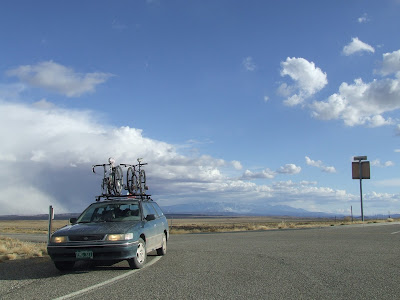
After a long journey, I finally rolled into the Alta Peruvian Lodge on Friday night. I was wired, tired, and stinky from two days of mountain biking in Moab. My car was dirty, running poorly, and the new home of a stowaway mouse.I'm not sure how or where he got in, but he quickly made himself at home in my glovebox with a nice bed of seat-stuffing. The mouse has so far eluded two peanut-butter rigged mousetraps and made a daring escape from a bag of bagels just as I picked up the bag. As it stands right now, I'm not sure what to do about the mouse, but I feel he's proven himself worthy of living in the car until I figure out a way to get him out.
the car north of moab, with mouse aboard.
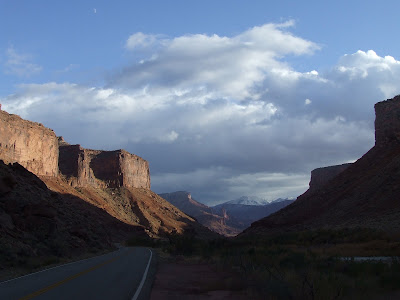
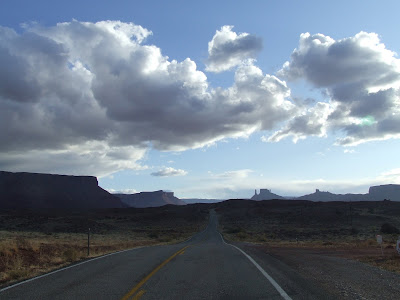
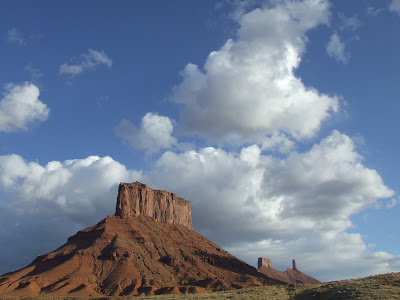
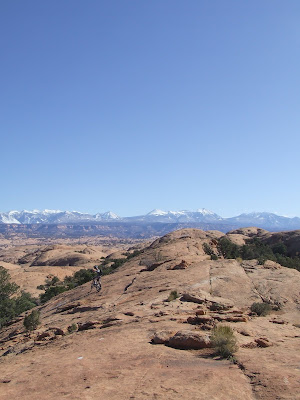
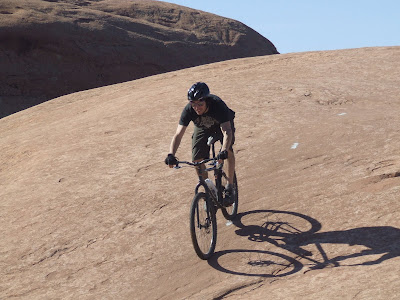
As for mountain biking, my buddy Kyle and I rode some great stuff in the Moab area. The first day was on the Slickrock trail, generally regarded as the most famous mountain bike trail in the world. The trail consists mostly of riding on sculpted domes of sandstone on a mesa with views of Moab, Arches National Park, and the La Sal Mountains. Overall the riding isn't spectacular, but it's definitely very aesthetic and a real icon of mountain biking.
Kyle with the La Sal mountains in the distance
Riding down one of the sandstone domes
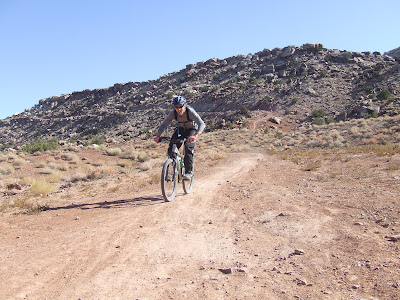
Our second day was at the Sovereign Singletrack, which is a really well built trail network that travels on several rocky ridges in the sandy desert north of Moab. There are lots of technical climbs, scary downhills, and awesome lines through streambeds and between boulders. Definitely top-notch.
Kyle motoring down one of the ridges at Sovereign
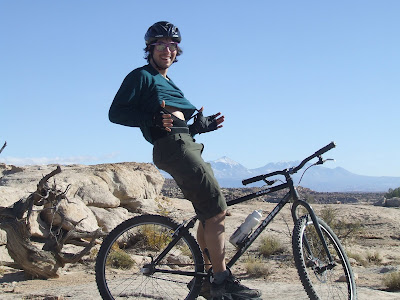
My mountain biking style in full effect
On the snow front, Alta received some 46 inches of snow two days before I got here. Yesterday I hiked to the top of the Wildcat lift to ski Westward Ho. I had visions of sailing through the powder, arcing beatiful, perfectly executed turns (I practiced in my head all summer) but I ended up falling a lot and generally beating it up. But regardless of that, I'm still pumped up to ski this season. Most of my friends from last year are already here, and we're all ready to get after it. This year I'm going to start skiing some of the massive backcountry opportunities to be had straight out my door. Since I'll be working in the ski shop this year, I can get really good discounts on the gear I'll need (20% off wholesale!?!) so that should make things that much easier.
 |
| From Utah 08-09 |
the car north of moab, with mouse aboard.
 |
| From Utah 08-09 |
 |
| From Utah 08-09 |
 |
| From Utah 08-09 |
As for mountain biking, my buddy Kyle and I rode some great stuff in the Moab area. The first day was on the Slickrock trail, generally regarded as the most famous mountain bike trail in the world. The trail consists mostly of riding on sculpted domes of sandstone on a mesa with views of Moab, Arches National Park, and the La Sal Mountains. Overall the riding isn't spectacular, but it's definitely very aesthetic and a real icon of mountain biking.
 |
| From Utah 08-09 |
Kyle with the La Sal mountains in the distance
 |
| From Utah 08-09 |
Riding down one of the sandstone domes
Our second day was at the Sovereign Singletrack, which is a really well built trail network that travels on several rocky ridges in the sandy desert north of Moab. There are lots of technical climbs, scary downhills, and awesome lines through streambeds and between boulders. Definitely top-notch.
 |
| From Utah 08-09 |
Kyle motoring down one of the ridges at Sovereign
 |
| From Utah 08-09 |
My mountain biking style in full effect
On the snow front, Alta received some 46 inches of snow two days before I got here. Yesterday I hiked to the top of the Wildcat lift to ski Westward Ho. I had visions of sailing through the powder, arcing beatiful, perfectly executed turns (I practiced in my head all summer) but I ended up falling a lot and generally beating it up. But regardless of that, I'm still pumped up to ski this season. Most of my friends from last year are already here, and we're all ready to get after it. This year I'm going to start skiing some of the massive backcountry opportunities to be had straight out my door. Since I'll be working in the ski shop this year, I can get really good discounts on the gear I'll need (20% off wholesale!?!) so that should make things that much easier.
Subscribe to:
Posts (Atom)
